ACL Reconstruction Recovery: Why 12 Months Is the Real Timeline
Six months after ACL reconstruction, your knee doesn't hurt. You've been cleared to jog. Your surgeon is happy with the scans and deems your knee to be structurally stable. So why does your physio keep saying "not yet" to running, cutting, or getting back on the pitch?
It's one of the most common frustrations we hear from athletes recovering from ACL surgery in London. Pain-free doesn't mean ready. And "cleared by the surgeon" is the start of the return-to-sport conversation, not the end of it.
If you're navigating ACL rehab right now, here's what we want you to understand about the real timeline, why we test your quads rather than just ask how your knee feels, and why rushing back early is one of the biggest risk factors for re-injury.
Recovery Is Five Phases, Not One Long Block
One of the most common mistakes in ACL rehab is treating it as a single, undifferentiated slog of "exercises" from week one to month twelve. In reality, a well-structured ACL journey moves through distinct phases, each with its own goal and its own exit criteria before you're allowed to progress:
Protection — restoring full range of motion, controlling swelling, and reactivating the quadriceps without disturbing the healing graft
Load Introduction — establishing key strength patterns (squat, hinge, step) and reintroducing controlled load through the knee
Strength Accumulation — building genuine strength and hypertrophy, and beginning a graded return to running
Training Integration — reintroducing sport-specific training, change of direction, and contact
Return to Performance — return to play, and beyond, to actual sporting performance
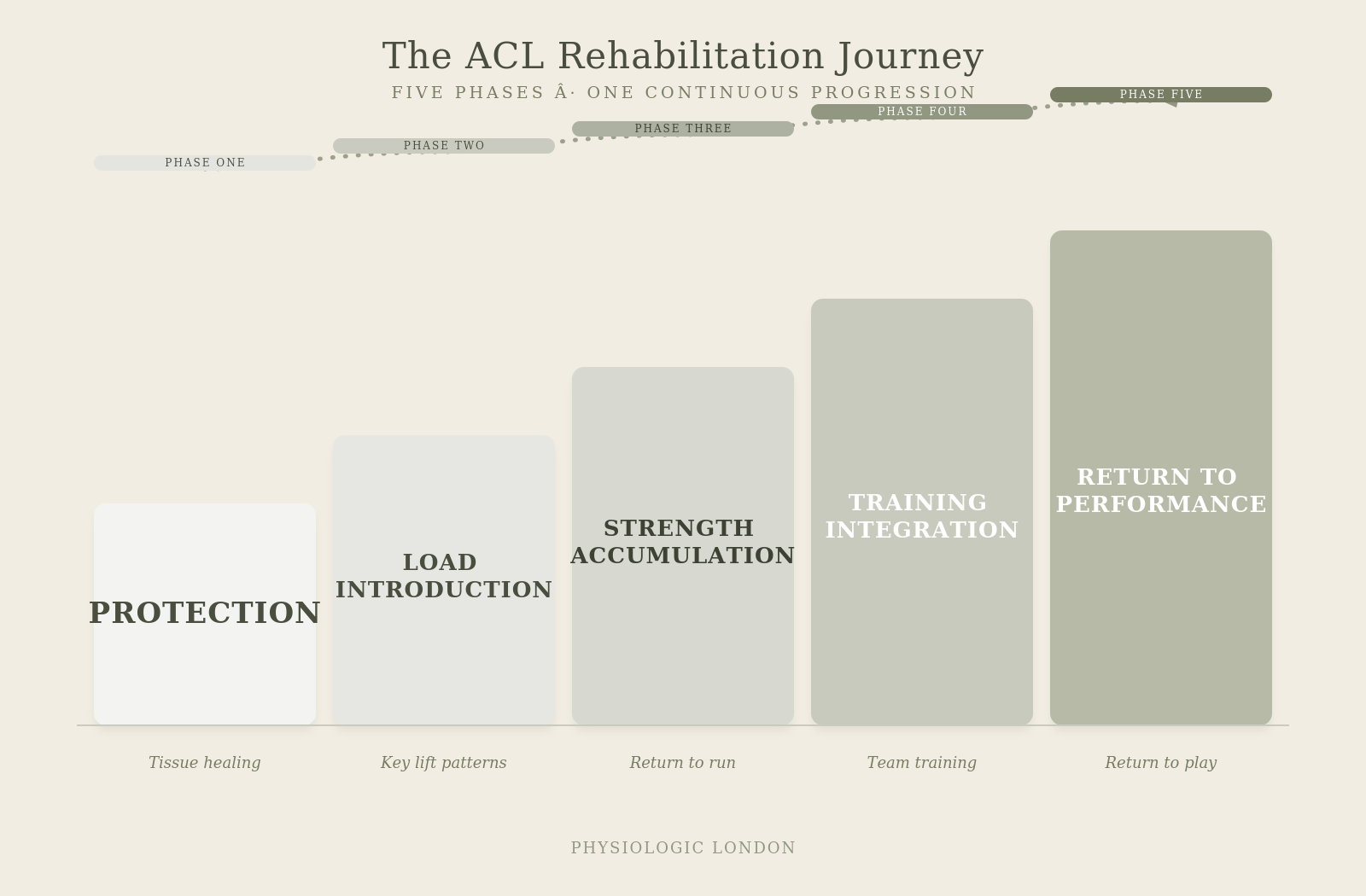
This is a framework we lean on heavily at Physiologic, influenced by the work of performance rehab specialists like Athletes Authority in Sydney. The key principle is that each phase earns the next. You don't graduate from Protection to Load Introduction because six weeks have passed on a calendar. You graduate because your knee has met the physical markers that phase demanded — full extension, no effusion, a normal gait pattern etc.
Time-based rehab is comfortable because it's predictable. But your graft, your tissue healing, and your nervous system respond to what you actually do and how your body actually adapts.
A common example is in the strength accumulation phase, where many clients are already starting to feel more ‘normal’, they’re walking well, back at work without crutches, and able to participate in social activities…and they may start missing gym sessions because life gets in the way. A consequence of that, is that progress stagnates, and they aren’t building the strength they need to enter the ‘Training Integration’ phase safely. We can’t ethically clear you to enter that phase just because it is 6 months post op and your knee strength is still lagging behind.
This is why a criteria based progression is the safest, most effective way to guide you along your ACL rehabilitation journey.
Why We Test Your Quads (Not Just Ask How You Feel)
Quadriceps weakness after ACL reconstruction is close to universal, and it's far more stubborn than most people expect. Left unaddressed, deficits of 28-40% compared to your uninjured leg have been recorded more than two years after surgery.
To give you a real life example, I recently started looking after a client who had an ACLr 7 years ago, and she came to see me because she just couldn’t keep up with her Barry’s HIIT Class! Upon my assessment, she still lacked the terminal (crucial) knee extension range, and her quadricep strength was 36% weaker compared to the uninjured leg. It wasn’t until we properly tested it that she realised how much work she needed to do to build it back up, in order to get back to doing the things she loves.
This matters because your quadriceps are doing a huge amount of work to protect your knee, control deceleration, and absorb load through running and landing. A knee that "feels fine" can still be running on a significantly weaker engine than the other side, and that asymmetry is one of the strongest predictors we have of both reduced performance and re-injury risk.
This is why objective testing matters more than subjective readiness. Research consistently uses a Quadriceps Limb Symmetry Index, essentially comparing the strength of your surgical leg to your other leg, as a key decision point:
A minimum of roughly 60-70% symmetry is generally needed before it's considered safe to begin structured running
Most return-to-sport frameworks look for 90% symmetry or higher before clearing an athlete for training integration and competitive return
Without measuring this directly, you're guessing. "It feels strong" is not the same as "it tests strong," and the gap between the two is exactly where re-injuries happen. This is a core part of how we structure ACL rehab at Physiologic, testing strength objectively at key milestones rather than relying on time or how the knee feels that day.
Testing quadriceps strength using the EasyForce dynamometer at Physiologic London. This gives us an objective limb symmetry score rather than relying on how the knee feels.
Why We Don't Rush the 12-Month Mark
Here's the number that surprises most patients: even when everything goes well, we generally don't clear athletes for full unrestricted return to sport before 12 months post-surgery.
This isn't overcaution. It reflects what's actually happening inside your knee. Your ACL graft doesn't behave like normal ligament tissue from day one. It goes through a biological process called ligamentisation, where the graft is gradually remodelled and revascularised to take on the mechanical properties of a true ACL. This process is still ongoing well beyond six months, and returning to high-risk, pivoting sport before it's sufficiently mature is one of the clearest risk factors for graft failure.
The data backs this up.
"For every month return to sport was delayed, up to 9 months post-surgery, the risk of a subsequent knee injury dropped by roughly 51%."
— Grindem H, et al.Nonsurgical or surgical treatment of ACL injuries: knee function, sports participation, and knee reinjury: the Delaware-Oslo ACL Cohort Study. J Bone Joint Surg Am. 2014;96(15):1233.
This is one of the most cited findings in ACL research, and it's the reason a rushed return to sport is one of the biggest, and most preventable, risk factors we see. It's backed up by a body of further work on the same theme:
Criteria-based (not time-based) return to sport cuts reinjury risk by up to 84%. Grindem H, et al. Simple decision rules can reduce reinjury risk by 84% after ACL reconstruction: the Delaware-Oslo ACL cohort study. Br J Sports Med. 2016.
Fear of reinjury at the time of clearance predicts an actual second injury, independent of physical test results, which is why confidence and psychological readiness are assessed alongside strength, not instead of it. Paterno MV, et al. Self-reported fear predicts functional performance and second ACL injury after ACL reconstruction and return to sport: a pilot study. Sports Health. 2017.
Structured injury-prevention programmes continued after return to sport further reduce risk, and are most effective when maintained for 6+ weeks, more than once a week. Steffen K, et al. Br J Sports Med. 2013; Sugimoto D, et al. Br J Sports Med. 2014.
Other research shows fewer than a quarter of athletes successfully return to their sport within a 12-month window when following a genuinely criteria-based rehab process, and overall ACL re-injury rates sit around 25-30% when both the same and opposite knee are accounted for.
Those numbers aren't there to scare you. They're there to explain why your physio isn't just being conservative when they say "not yet." A 12-month timeline, built around measurable strength and movement criteria rather than a date on the calendar, is what actually gets you back to sport and keeps you there.
What Rehab Actually Looks Like
Numbers and phases are useful, but people generally want to know what the actual sessions involve. Here's a look at a few key exercises we use across the ACL journey:
Early in the protection phase, one of the key goals is to regain ‘normal gait’. Constraint based rehab like using these hurdles trains the body to relearn key qualities in optimal gait mechanics.
In the Training integration phase, we’re training qualities that are starting to mimic athletic demands. Here, we introduce impact, speed, and rapid deceleration through out Tall to Short series.
What This Looks Like at Physiologic London
If you're currently in ACL rehab, or coming up to surgery and want it done properly from day one, here's what we focus on:
Phase-based progression with clear physical exit criteria, not a generic time-based protocol
Objective quadriceps strength testing at key milestones, not just clinical impression
Realistic 12-month expectations, particularly if you're heading back into pivoting or contact sport
Close collaboration with your orthopaedic surgeon throughout, so your rehab and your surgical outcomes stay aligned
ACL recovery is a long journey, and it deserves more than a generic exercise sheet and a countdown of weeks. If you're working through ACL rehab and want a structured, criteria-driven plan built around your sport and your timeline, get in touch and we'll walk you through exactly where you are in the process and what's next.
ABOUT THE AUTHOR
Ryan Tan is a London-based Spinal and Sports Physiotherapist with over a decade of experience helping clients recover from complex injuries and return to the activities — and sports — they love.
He holds a Certificate of Spinal Manual Therapy (COSMT), an advanced qualification in spinal care, and is also trained in Osteopathic Spinal Manipulations (OMT).
Before relocating to London, Ryan was the Clinical Director of a leading physiotherapy clinic in Hong Kong, where he built a reputation for solving persistent spinal and sports-related injuries.
He now works closely with national-level sports doctors and knee specialists, providing evidence-based physiotherapy and advanced rehabilitation for high-performance and competitive athletes returning to sport.
Consulting in London across Canary Wharf and Soho, Ryan combines expert manual therapy, dry needling, and gym-based rehabilitation to deliver long-term solutions — not quick fixes.
If you’re struggling with an injury that’s been holding you back, Ryan offers personalised, one-on-one care to help you move better, feel better, and perform stronger.