Is Spondylolisthesis Rehab the Same for Everyone? A London Spinal Physio's Answer
A client of mine, currently going through the Spinal Solutions Program for his Spondylolisthesis Pain asked me a great question recently: "Do you treat everyone with spondylolisthesis the same way?"
As a physiotherapist in London specialising in spinal conditions, my short answer is yes. Well, at least the principles are the same. The specific exercises are not.
Here's why.
What spondylolisthesis actually is
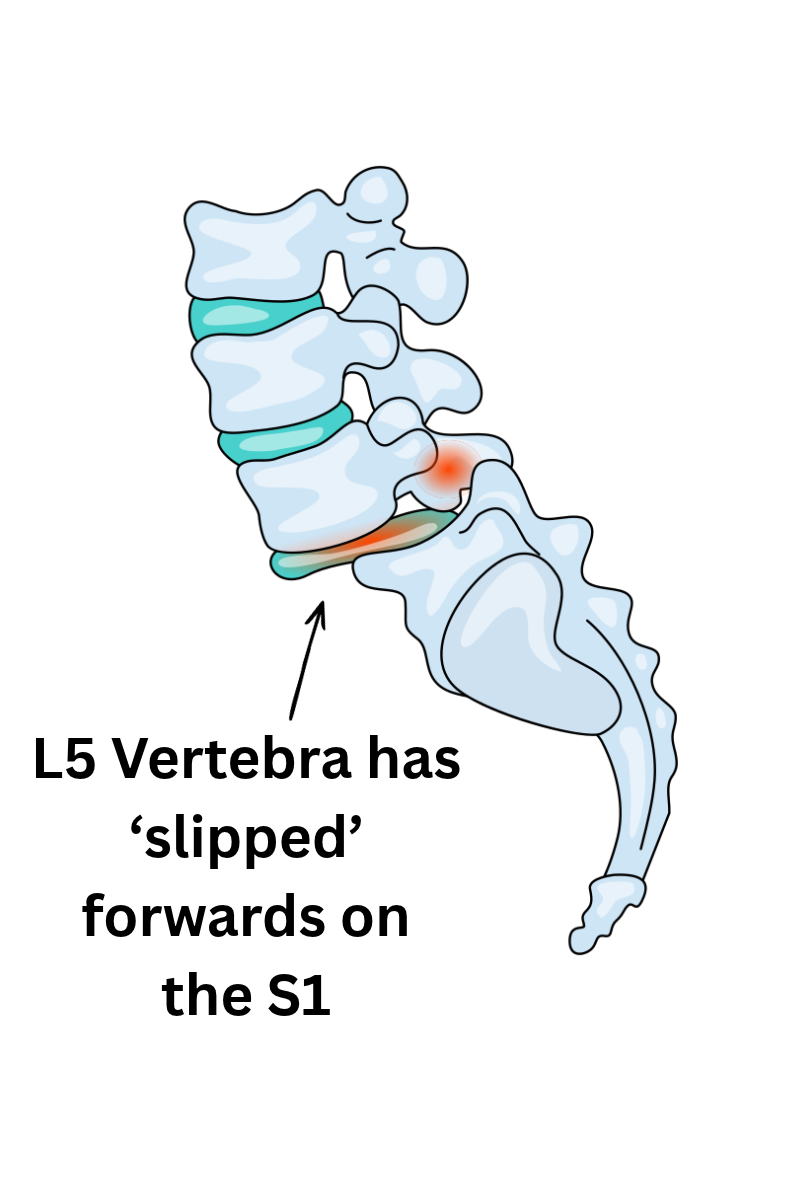
Spondylolisthesis is first and foremost a structural issue. One vertebra has slipped forward on the one beneath it, which places greater pressure on the facet joints at that level.
In mild cases, it often shows up as regular back ache, usually quite localised. As it becomes more severe, pain can refer into the buttocks and legs (similar to sciatica), and in some cases the nerves become compromised. If you want the full background, I've covered it in detail in my guide to managing spondylolisthesis.
Why most symptomatic spondylolisthesis looks the same
In my experience, most symptomatic spondylolisthesis presents very much like facet joint dysfunction. That makes sense, because it's usually a facet joint overload problem driven by the structural change.
The result is that people with this condition will usually (not always) struggle with extension based activities:
Prolonged standing
Running
Cobra stretches in yoga
Serving in tennis
Weightlifting
We classify these presentations as extension intolerant. This classification covers facet joint dysfunction, spinal canal stenosis, spondylolysis, and spondylolisthesis, because they all share the same problem with extension.
This is also why modern physiotherapy is moving away from being so fixated on the specific diagnosis when it comes to long term management. The diagnosis matters, but the movement pattern and the capacity deficits are what actually guide the plan. I've written more on that in “is a clear diagnosis crucial for managing spinal conditions”.
The 3 impairments I see again and again
When someone is extension intolerant, three impairments show up repeatedly.
1. Loss of trunk extensor strength and endurance. You'll see it when someone struggles to come back up from a flexed position, or when the lumbar spine hyperextends during a Romanian deadlift, deadlift, or squat. That hyperextension is a strategy. It shortens the lever arm for the trunk extensors, so the muscles work less, but it significantly increases the forces through the joint. Eventually that causes pain.
2. Loss of trunk flexor endurance and control. If the trunk flexors can't control the spine into extension, the facet joints take the load. You'll see it in a tennis serve, a cricket bowling action, or an inability to hold a neutral spine during deadlifts.
3. Loss of hip extension control. Tight hip flexors or postural changes can stop the hip from extending independently of the lumbar spine. The lower back then makes up the difference through hyperextension, and that becomes the mechanical driver of pain.
How the Spinal Benchmark Test shows these deficits
This is where objective testing earns its place. The Spinal Benchmark Test measures global core endurance capacity, and it makes the first two impairments visible straight away.
It's based on the McGill core endurance battery, and I compare each client against normative ranges split into three phases (Anderson et al. 2014; McGill, Childs and Liebenson 1999):
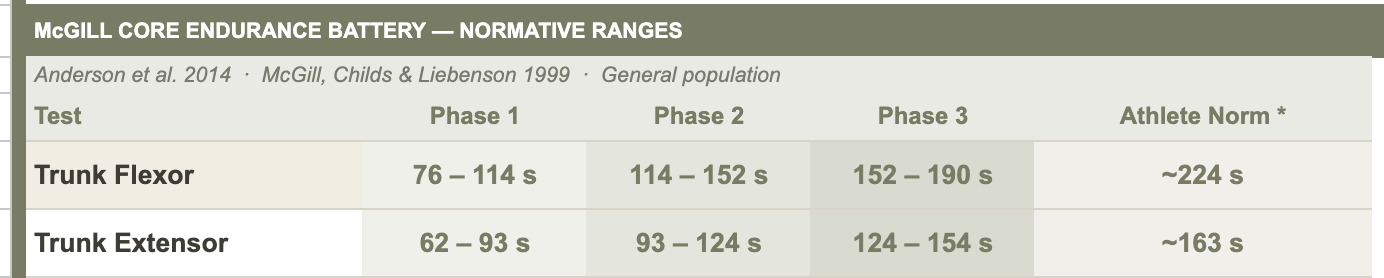
Normative data we use to benchmark our clients core capacity results.
For a young, healthy individual, I like to see scores sitting in the mid to high end of phase 2. For athletic individuals, I want the high end of phase 2 through to mid phase 3.
Here are two real clients (details anonymised).
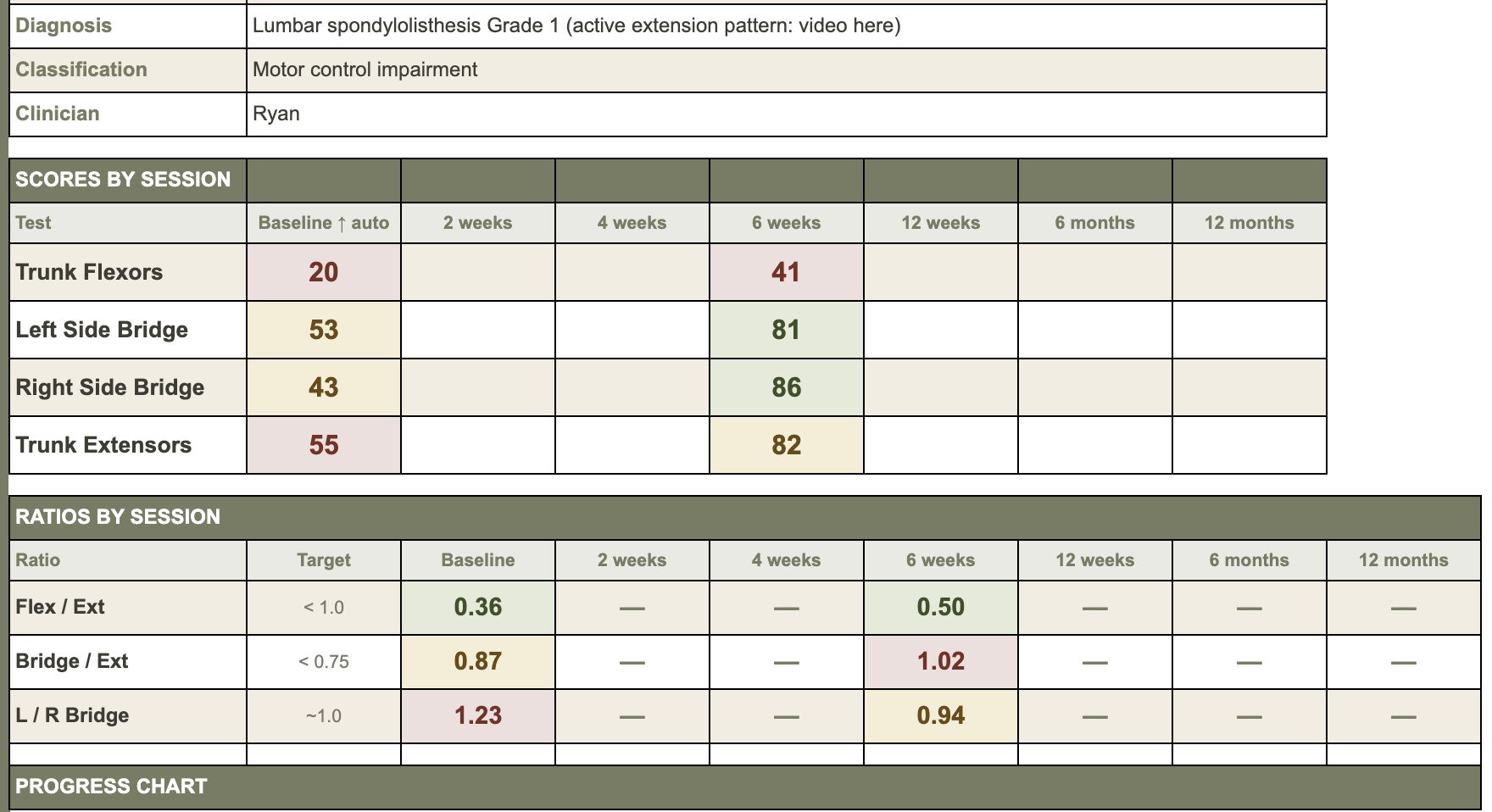
Client A: Grade 1 lumbar spondylolisthesis
At baseline, his trunk flexors held for just 20 seconds and his trunk extensors for 55 seconds. Both sit below the phase 1 range, a long way from where I'd want a young, healthy person to be.
After 6 weeks of targeted rehab, his retest showed:
Trunk flexor endurance improved by 105%, from 20 seconds to 41 seconds
Trunk extensor endurance improved by 49%, from 55 seconds to 82 seconds
His extensors are now inside the phase 1 range, and his flexors have more than doubled. There's still work to do, but the direction is clear, and it matched what he told me himself. He noticed a marked improvement in his symptoms and his quality of life.
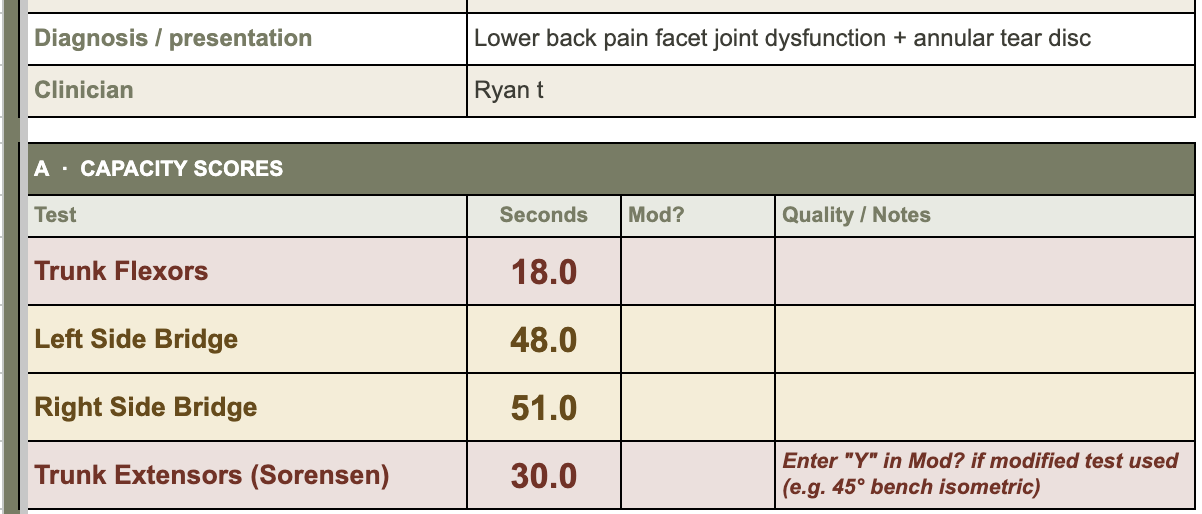
Client B: facet joint dysfunction with an annular disc tear (no spondylolisthesis)
His baseline showed trunk flexors at 18 seconds and trunk extensors at 30 seconds, again well below the phase 1 range.
Different diagnosis, same deficits: poor trunk flexor and extensor endurance. That's the point. When two people with different labels show the same capacity profile, it makes sense that the principles of their rehab look similar.
The test measures capacity, not movement quality, so I assess things like hip extension control separately. But it gives us a clear baseline, tells us where to focus, and gives the client something concrete to work towards.
The 3 rehab principles
1. Improve trunk extensor capacity. The initial focus is on building endurance without letting the spine over-extend.
2. Build trunk flexor control and capacity. I like to start with core exercises performed with a posterior pelvic tilt, so the client learns to control the spine out of extension.
3. Retrain hip extension. This means prone hip extension for inner range glute work, active mobility for the hip flexors, and most importantly, learning to dissociate hip extension from lumbar extension. That last skill is the one that changes how people move in everyday life.
So, do I treat all spondylolisthesis the same?
For most spondylolisthesis, yes. The principles of management are very similar, and they carry across the other diagnoses in the extension intolerant group too.
What changes is how each principle is delivered. The exercises I choose depend on the individual: their pain levels, current capacity, and ultimate goals.
Take a tennis player. Trunk flexor control for them must include some element of long lever, overhead demand at speed, because that's what their sport asks of their spine. A kneeling cable overhead crunch is one way I do that. Someone whose goal is simply to stand and cook comfortably would have a very different exercise.
Improving Trunk Flexor Control and Capacity with the overhead banded crunch.
Need some guidance on how to manage your spondylolisthesis?
If you've been told you have spondylolisthesis and you're not sure what to do about it, the Spinal Solutions Program is built around exactly this approach. It starts with a comprehensive assessment, looking at movement quality, mobility and the Spinal Benchmark Assessment, so we know your specific capacity deficits before we choose a single exercise.
As a London based physiotherapist specialising in spinal conditions and athletic injuries, this is the kind of problem I work with every week, and my goal is to help you manage your spinal pain without the need for surgery!
*If you have leg weakness, numbness, or any change in bladder or bowel control, please seek urgent medical attention rather than waiting for an appointment.
Frequently asked questions
Do all spondylolisthesis cases need the same exercises? No. The principles are shared, which are building trunk extensor capacity, improving trunk flexor control, and separating hip extension from lumbar extension. The exercises themselves depend on your pain levels, current capacity, and goals.
Why does spondylolisthesis hurt when I stand for a long time or extend my back? The forward slip of the vertebra increases the load on the facet joints, and extension compresses those joints further. That's why standing, running, yoga cobra stretches, and overhead sports like tennis serving tend to provoke symptoms.
What is extension intolerance? It's a movement-based classification for people whose symptoms are provoked by extension based activities. It includes facet joint dysfunction, spinal canal stenosis, spondylolysis, and spondylolisthesis.
Can I still lift weights with spondylolisthesis? In most cases, yes, but how you lift matters. Hyperextension through the lumbar spine during squats, deadlifts, and Romanian deadlifts is often what drives symptoms, so the focus is building the capacity to hold a controlled position under load.
What is the Spinal Benchmark Test? It's a core endurance assessment I run with every client. It measures the capacity of your trunk flexors, extensors, and side bridge muscles, and gives us a clear baseline to build your rehab around. You can read the full breakdown here.
Do I need a physiotherapist who specialises in spondylolisthesis? It helps to see someone who understands spinal conditions in depth and tests capacity objectively rather than guessing. That's what I do at Physiologic in London.
About the author
Ryan Tan is the founder of Physiologic based in London, a physiotherapy practice specialising exclusively in complex spinal conditions and sports injuries.
With over a decade of clinical experience across Australia, Hong Kong, and London, Ryan holds a Certificate of Spinal Manual Therapy (COSMT) and is trained in Osteopathic Spinal Manipulation (OMT). He has worked in complex pain clinic settings alongside pain consultants and spinal neurosurgeons, and continues to work with some of London's leading orthopaedic spinal surgeons to deliver integrated, expert care for clients with complex spinal presentations.
Ryan's focus is on helping active adults with persistent lower back pain, disc herniations, and nerve-related conditions return to training, sport, and the life they want — without unnecessary surgery. He currently sees clients with complex conditions such as disc herniations, spondylolisthesis, and Bertolotti's Syndrome across Canary Wharf, Soho, and Moorgate.