
Is Your Spine Strong Enough? Inside the Spinal Benchmark Test We Run With Every Client
How do you actually know if your spine is strong enough to handle what you're asking it to do?
Most people find out the hard way, after a niggle turns into a flare-up, or a flare-up turns into something that keeps coming back. Before we build a rehab program for anyone at Physiologic London, we run them through the Spinal Benchmark Test: four simple strength and endurance tests that show us exactly where the weak links in your spine are.
Here's what the test involves, why we use it, and what it can (and can't) tell you.
What is the Spinal Benchmark Test?
The Spinal Benchmark Test is a series of four isometric hold tests, based on the core endurance testing protocols developed by spine biomechanist Dr Stuart McGill. Instead of measuring how much weight you can lift, it measures how long the muscles around your spine can hold a position under load. That endurance number, and how it compares across the four tests, tells us a lot about how your spine is coping day to day.
We use it with every client who comes to us with a spinal injury, because it gives us an objective starting point rather than a guess. The results of this test has an added benefit of benchmarking you against age-matched individuals, which gives you an indication of where you’re at, and what you need to aim for.
Why we test before we treat
When you're dealing with back pain, it's tempting to jump straight into exercises. The problem is that two people with what looks like the same back pain can have completely different weak points. One person might have plenty of strength in their lower back but very little side-to-side stability. Another might have the opposite. Without testing, you're building a program on assumptions.
Running the Spinal Benchmark Test first means every program we build is based on where your capacity actually falls short, not on a generic template.
The four tests explained
1. Back extension hold (trunk extensors)
This looks at the muscles along the back of your spine and how long they can hold you in an extended position. It's a direct measure of posterior chain endurance, one of the most common areas we see contributing to ongoing back pain.
2. Trunk flexor hold
This tests the muscles at the front of your trunk, held in a supported sit-up type position. It shows us how well your flexor muscles can hold their own compared to your extensors.
3 and 4. Left and right side plank holds
The third and fourth tests are maximum side plank holds, one on each side. These assess lateral stability, which is a commonly overlooked area when people think about spinal strength. Most people focus on front and back, but side-to-side control matters just as much.
How we score and interpret the results
Your raw scores will firstly be stacked up against our normative data, so you can see exactly where your spinal capacity is at compared to age matched individuals.
If you’re moderately actively and not currently participating in any regular intense physical activity, you should be aiming to be in Phase 2 for all your tests, that means holding a sit up position for at least 115seconds, side plank of just under a minute on each side, and at least 93 seconds for the back extensor hold.
For those who are currently participating in higher intensity activities, you should aim to be in the higher Phase 2-Phase 3.
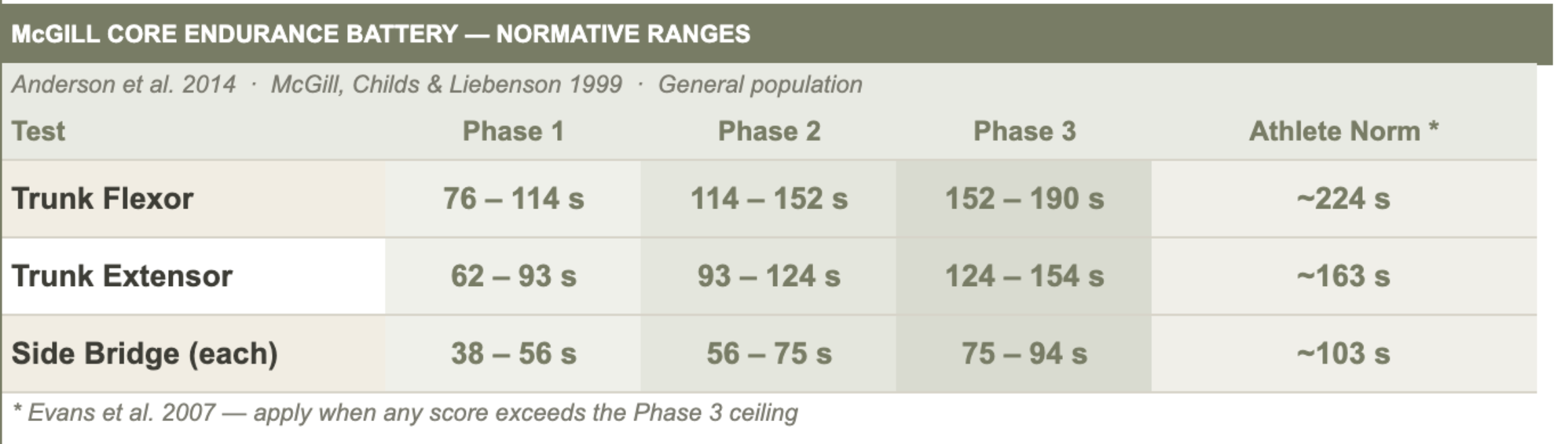
At Physiologic London, our Spinal Benchmark tests gives meaning to your scores, and it serves as a goal for our clients (extremely motivating!).
Once we've timed each hold, we put the results into our assessment spreadsheet, which calculates a set of ratios:
Flexor to extensor ratio (target under 1.0)
Side bridge to extensor ratio (target under 0.75)
Left to right side bridge ratio (target close to 1:1)
These ratios matter more than any single number on its own. If one side is significantly stronger than the other, or if your flexors are massively outperforming your extensors, that tells us there's a discrepancy worth addressing in your program.
What this test can (and can't) tell you
This is the part we think gets skipped over a lot in fitness content, so we want to be clear about it.
The Spinal Benchmark Test gives us an overall picture of your capacity, meaning how well your muscles can function and endure under load. What it doesn't do is tell you exactly what's causing your pain, and it doesn’t tell you anything about the QUALITY of your movement.
What it tells us is that certain muscles may be weak and may be contributing to your condition. It's not causative, it's a contributor. Even with a low score across the board, the test alone can't diagnose you. It's one input into a broader assessment, alongside your history, your movement patterns, and your specific symptoms.
Even so, it's a genuinely useful tool. It gives us a clear, repeatable way to guide your rehab program so the exercises you're doing are targeting what your body actually needs, not just what worked for the last person we saw.
Where testing fits into your rehab program
Once we have your Spinal Benchmark results, they become one of the starting reference points for your program, whether that's our Spinal Solutions Program for chronic or complex back pain, or a return-to-sport plan after an injury. As you progress, we retest to track whether your capacity and your ratios are actually improving, not just whether your pain has changed.
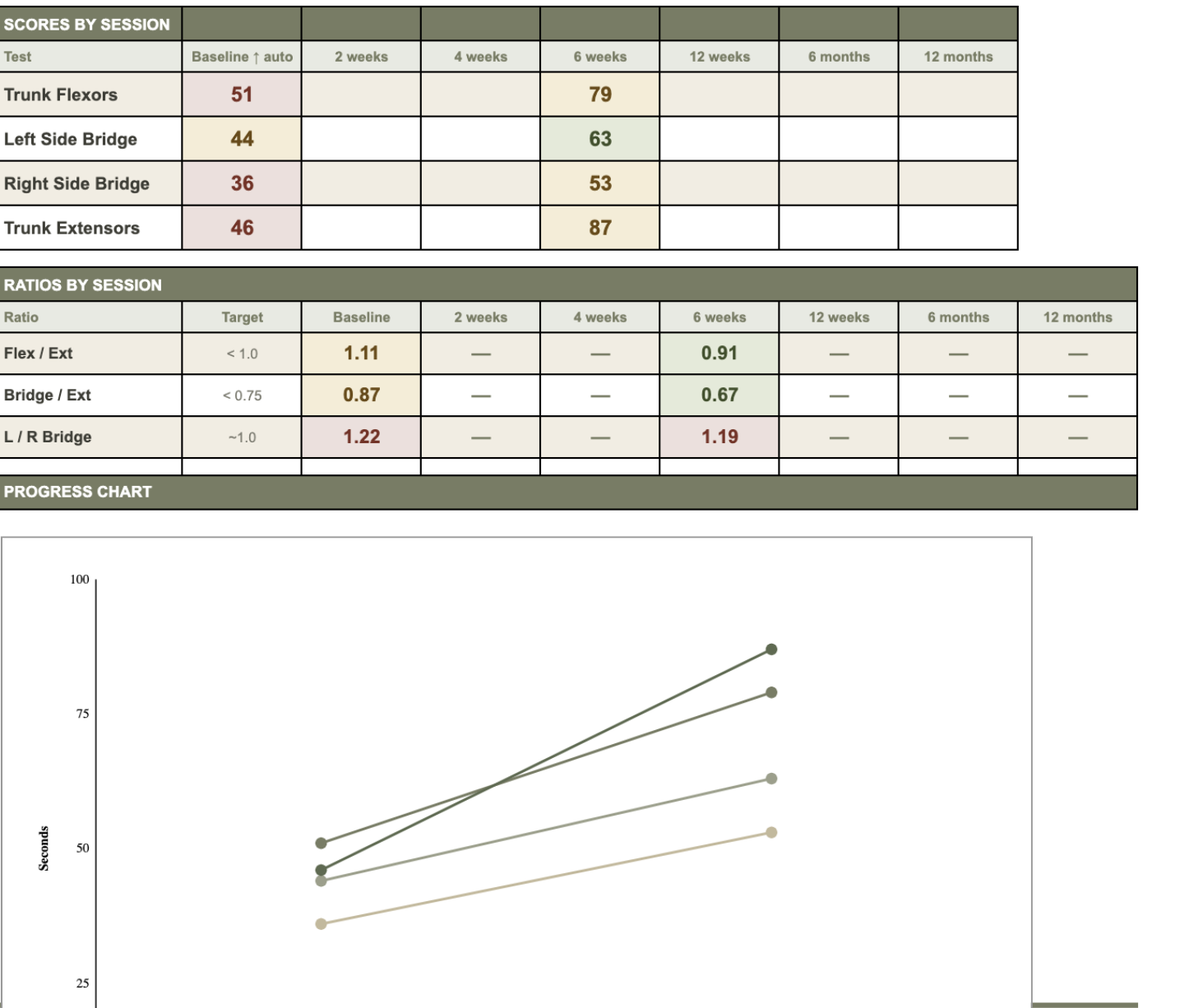
An example of a 6 week re-assessment of the Spinal Benchmark Test. Each test showed significant improvement, and it correlated with a significant reduction in symptoms, and more confidence in my clients capacity to tolerate load.
Watch the full breakdown
Prefer to see the test in action? I walk through what each test looks like and how we score it in this video.
Find out where your weak points are
If you've been dealing with back pain that keeps returning, or you just want to know how your spine actually holds up under load, we'd be glad to run you through a full Spinal Benchmark Assessment. Having objective data that also stacks you up against age-matched individuals is an invaluable tool to give you clarity and direction on where your rehabilitation program should head.
When to See a Spinal Physiotherapist in London
If your pain has been going on for more than 6 weeks, is stopping you training, or you just feel lost with your recovery journey, it is worth having a proper spinal assessment sooner rather than later.
👉 Sports & Spinal Physiotherapy in London — Learn More
About the Author
Ryan is a specialist Sports & Spinal Physiotherapist with over a decade of clinical experience across Australia, Hong Kong, and London. He holds a Certificate of Spinal Manual Therapy (COSMT) and is trained in Osteopathic Spinal Manipulation (OMT).
He has worked in complex pain clinic settings alongside Pain Consultants and Spinal Neurosurgeons, and currently works with some of London's leading orthopaedic spinal surgeons to deliver integrated, expert care for clients with complex spinal conditions.
At Physiologic London, Ryan specialises in helping active adults with persistent lower back pain, disc herniations, and nerve-related conditions return to training, sport, and the life they want to live — without unnecessary surgery. Ryan currently provides specialist Spinal Physiotherapy solutions for people with complex conditions such as disc herniations, spondylolisthesis, Bertolotti’s Syndrome and more, across Canary Wharf, Soho and Moorgate.