As a Physiotherapist specialising in rebuilding complex spinal conditions in London, Disc protrusions and Sciatica is the most common lower back injury presentation that we manage.
Most acute disc protrusion injuries will naturally heal and settle within 10 to 12 weeks, with the first 6 to 8 weeks having the potential to be extremely painful, affecting all aspects of your daily life like your sleep, activity levels, being able to participate in social activities etc.
Once your pain settles, many people share the same fear, being ‘I don’t want to re-injure my back’.
From here, they have two choices:
1: Completely avoid anything strenuous or vigorous out of fear of re-injury.
2: Commit to uncovering the potential reasons WHY they developed this issue in the first place, and get on a rehabilitation plan that aims to improve their mobility, strength, and most importantly, confidence in their spine.
My career is dedicated to help people who choose option 2, who want to overcome their spinal injury, build their strength and confidence, and get back to the things they love, and we have extensive scientific evidence that supports this approach.
You don’t want to be the person with the bad back forever. You don’t have to be. The gap between pain free and confident is measurable, and it can be closed.
What is a disc protrusion?
A disc protrusion is when part of a spinal disc pushes out past its normal border. You might have heard it being called a disc bulge or a slipped disc. When it irritates a nearby nerve, it can cause leg pain, often described as sciatica or a trapped nerve.
It’s specific and diagnosable, with most disc protrusions occurring in the lower lumbar spine (L4/L5 or L5/S1 as they are the most weight bearing segments of your spine).
Most disc protrusions are sensitive to flexion: repeated bending, long periods of sitting and loaded forward movement tend to aggravate them. After a disc protrusion or a microdiscectomy, the weak link I find most often is the back extensors. This muscle group is responsible for controlling load into flexion.
Our Spinal Benchmark Testing aims to detect the particular muscle groups that are weak, quantify their capacity, and use the data to build specific rehabilitation programs aimed at improving your spinal ability.
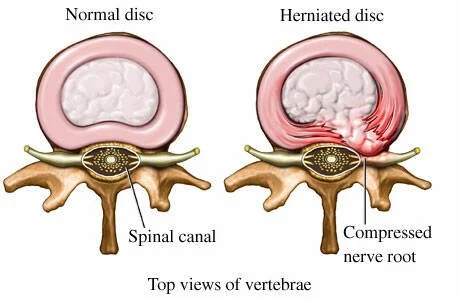
Disc Protrusion (also known as slipped disc, herniated discs or dic bulge).
Why does disc protrusion rehab stall?
Rehab usually stalls because avoiding load becomes the default coping mechanism. Cutting out aggravating movements early on in the acute phase (0-6 weeks) is absolutely the right thing to do, but when there isn’t a plan to reintroduce, or recondition the spine, you slowly lose the ABILITY to do so, and develop fear around the movement.
You haven’t been shown HOW to rebuild confidence in your spine.
It isn’t uncommon for people to have their pain reduce over the 10-12 week period, but find that every time they try to get back to running, or the gym, they experience a flare up, and they go through the same cycle of stopping gym, let the pain settle, then go back only for it to flare again.
It takes a thorough assessment, like our Spinal Benchmark Test to determine what your current strength levels are, then to build a program that targets your weak links and actually progresses you TOWARD your goals.
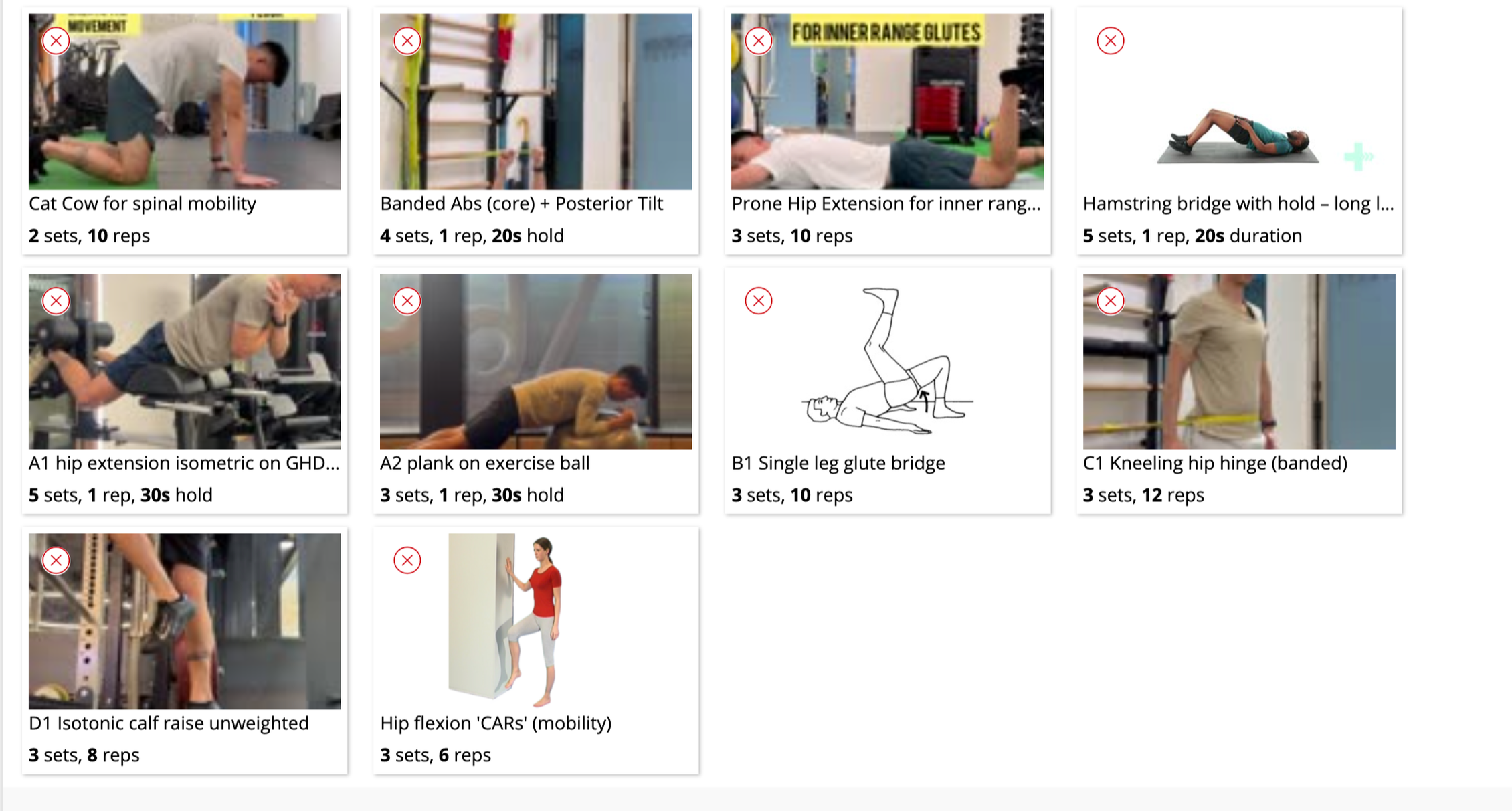
Example of a specific rehabilitation program for a Disc Protrusion.
How do you know if your back is strong enough after a disc injury?
You test it. Every spinal client I see does the Spinal Benchmark Test, which is built on Stuart McGill’s core endurance battery. It measures how long you can hold your trunk flexors, back extensors and side bridges, and compares the ratios between them.
It doesn’t tell me everything, because it doesn’t assess movement quality. But it gives an objective number for something most people only guess at, and it shows me where the weak link is. For many people coming back from a disc injury, that’s the back extensors.
Read this article to learn more about what The Spinal Benchmark Test is.
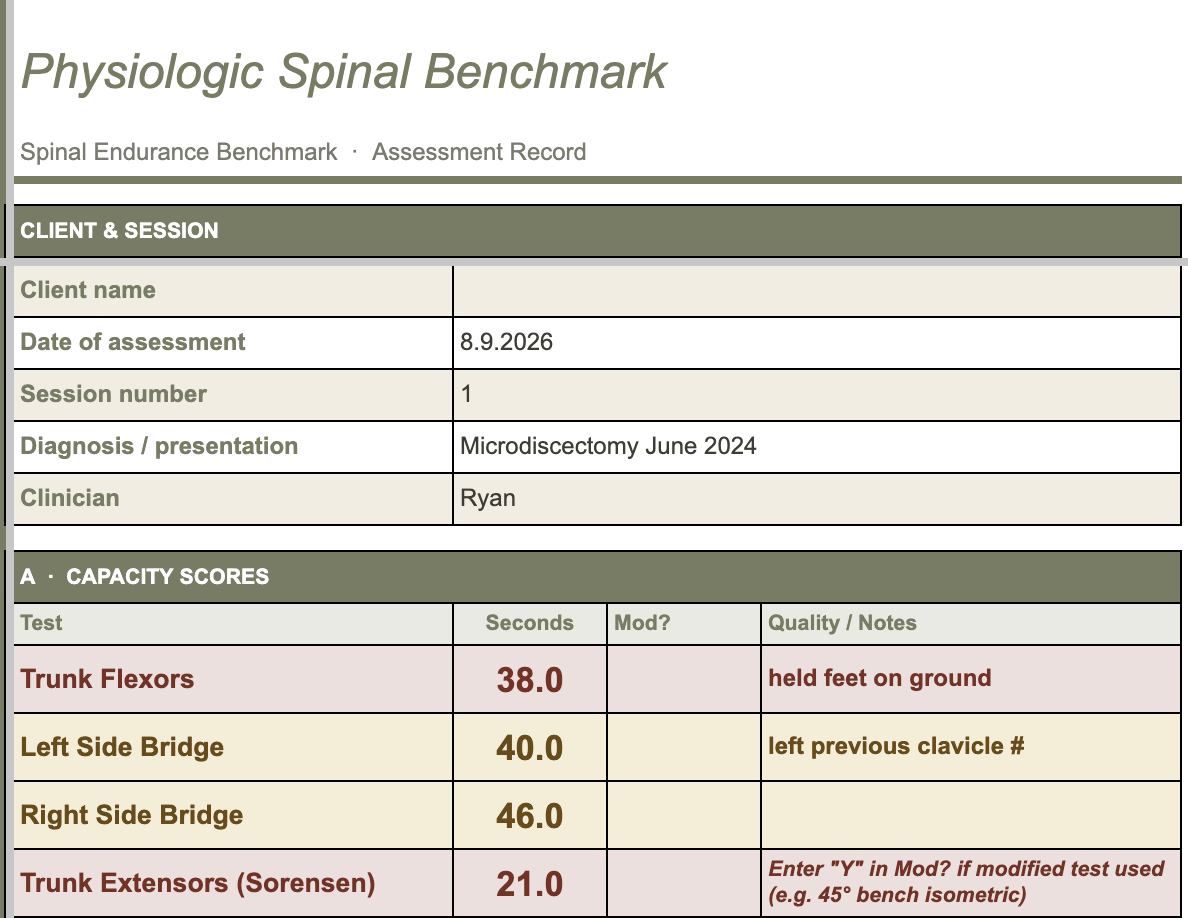
The image below is a prime example of just how de-conditioned the spine can get.
This client could only hold a their trunk extensors for 21 seconds, where a healthy young adult should be able to hold for at least 90 seconds!
Not sure where your back stands?
Get your Spine Health Score in 15 quick questions. You’ll also get 3 things you can do today to start rebuilding.
Take the free quiz: https://spinehealthscore.scoreapp.com
Case study: can you return to sport 2 years after a microdiscectomy?
Yes. Earlier in the year I had a client who consulted me 2 years after a microdiscectomy. His surgery had done its job in reducing pain, but he wanted to get back into sport but didn’t trust his back. He was fearful of loading it and had largely stopped trying.
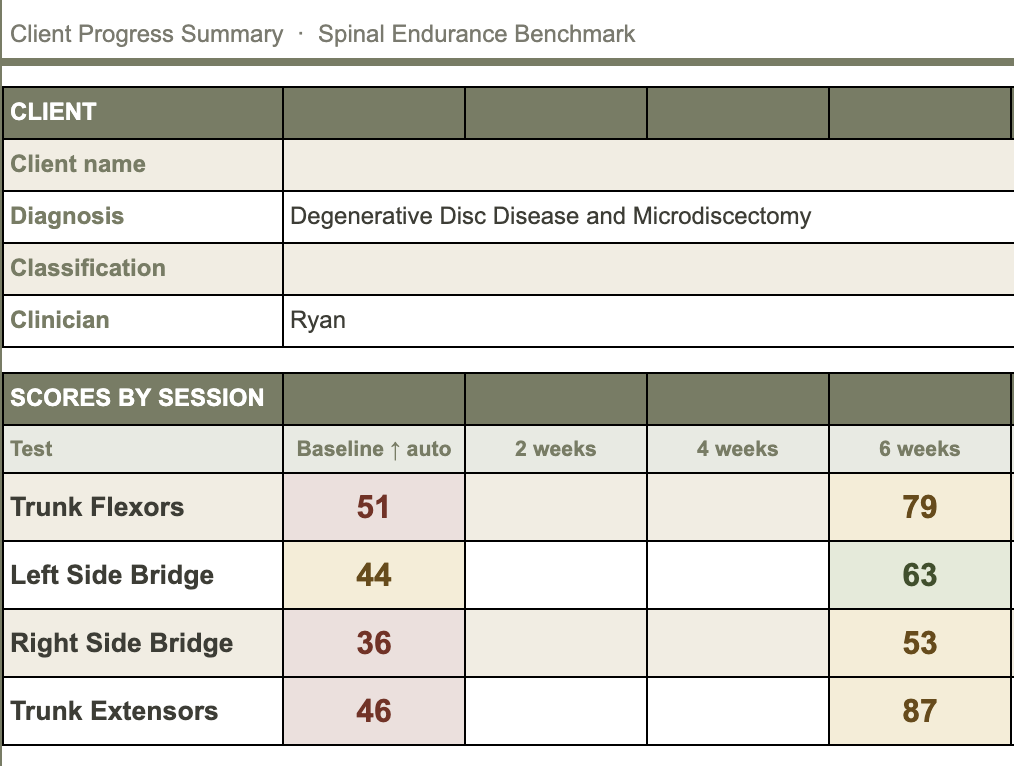
On the Spinal Benchmark Test, his back extensor hold was 46 seconds against a target of 160 seconds for his safe return to sport. Not to mention he was so deconditioned globally, and that’s something we can change.
The first priority was building capacity in a way he felt safe doing.
After 6 weeks, his back extensor hold was 87 seconds, an improvement of an impressive 191%.
At this point, he’s reported these improvements
Much less flare ups in pain
More confident in loading up his spine
Very hopeful and positive in achieving his dream of returning to sport.
Objectively stronger and more mobile.
What’s the best exercise for weak back extensors after a disc injury?
The one I prescribe most is the GHD back extension isometric. You hold your body in a straight line with your spine neutral, so your back extensors build endurance without your spine bending under load.
Watch it here!
Why it works:
The spine holds a neutral position, so there’s no repeated bending under load
It trains endurance, the quality I see missing most often after a disc injury
It’s easy to scale by changing hold time, arm position or adding weight
It’s objective. You know exactly how long you held, so progress is visible
How to do it:
Set the hip pad just below your hip bones so the hinge sits at your hips, not your lower back
Lock your feet under the rollers and cross your arms over your chest
Lift into a straight line from head to heels. Brace lightly and squeeze your glutes
Keep your neck neutral and breathe steadily
End each hold when your position starts to drop, not when it starts to burn
Starting point: 3 to 5 holds of 10 to 20 seconds, with equal rest. Build your total hold time week to week.
Progressions: hands behind your head, then arms extended overhead, then holding a weight plate to your chest.
If you don’t have access to a gym/GHD machine, you can also do a similar exercise at home, watch it below!
How does physio for a disc protrusion work?
Every physio will have their own approach to managing disc injuries, and there is no single ‘right’ or ‘wrong’ approach (in my opinion).
Here’s a simple breakdown of how I structure a physiotherapy plan to help people with disc injuries overcome their injury, and regain their confidence in their spine. The testing, and subsequent rehabilitation programs are all included in our signature Spinal Solutions Program.
The first meeting. I want to get to know who YOU are. What your life looks like, what you’re struggling with, what your goals are.
Once I get to know a bit about you, we get onto physical, objective TESTING. We try to only measure what matters, and the initial conversation in step 1 actually helps to dictate what we measure. As a general rule, we will measure outcomes like your mobility, neurological tests, functional movement and strength testing (including Spinal Benchmark Testing and VALD Force Plate Testing if appropriate). See the below image for an example of an INTENSIVE profiling session with an athlete with complex spinal pain.
From the data we obtain, and reverse engineering from your end goal, we can construct a rehabilitation program that is specific to YOU, that fits into your lifestyle, while giving you the roadmap to help achieve your ultimate goal.
Every 6 weeks we will reassess, and progress the program to based on the new assessment data.
Rinse and repeat.
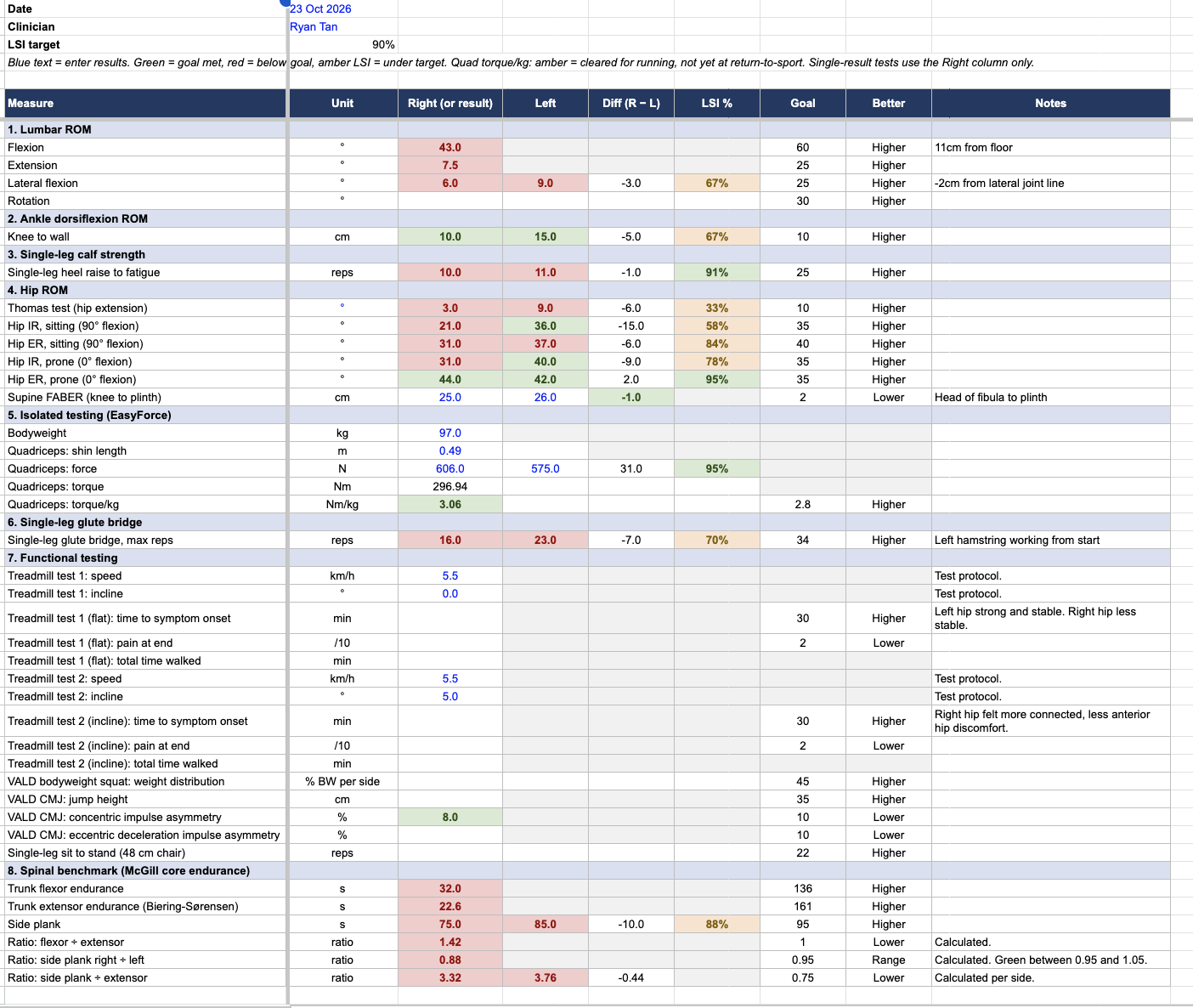
Objective testing data for an athlete with complex, chronic lower back pain.
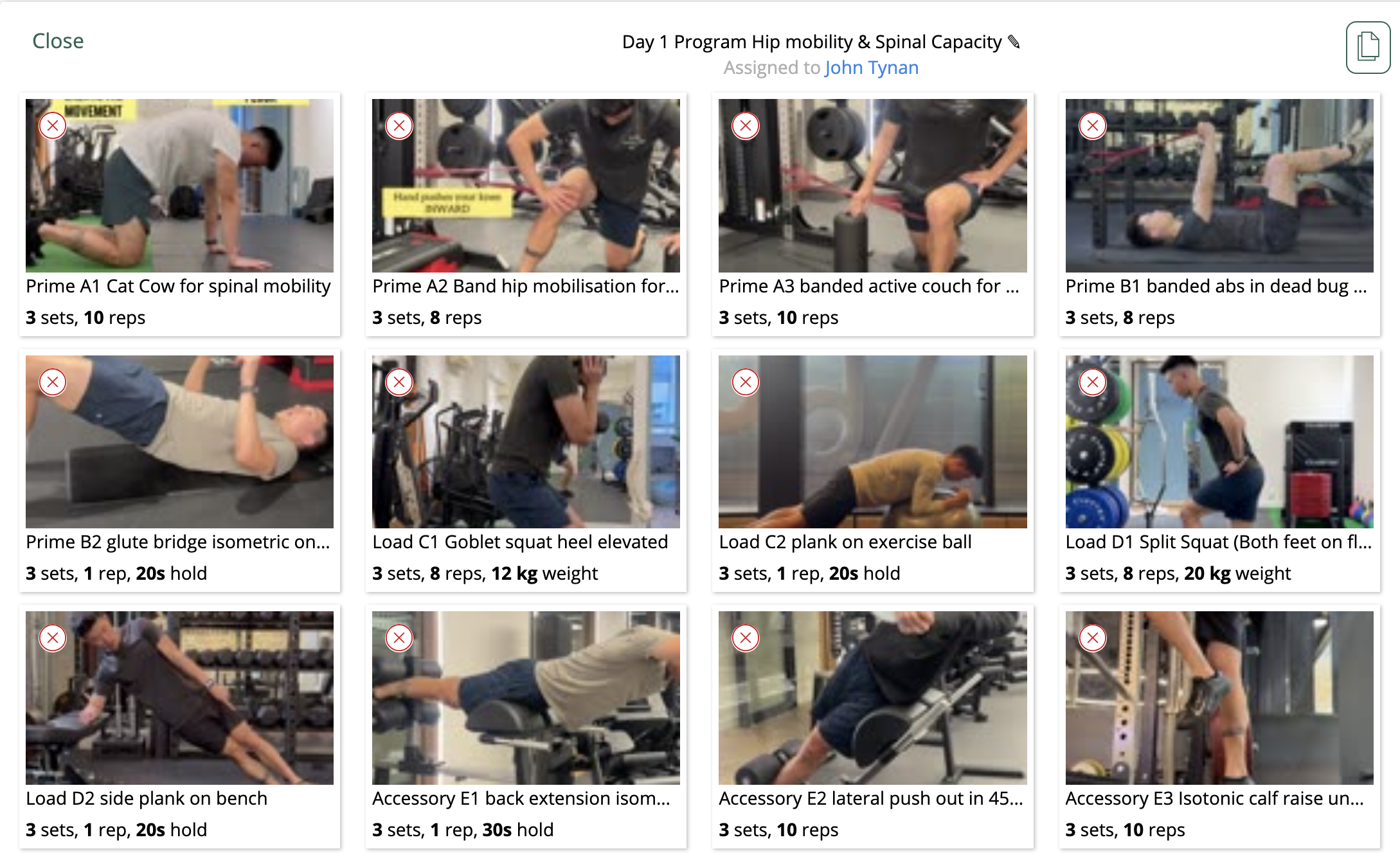
Based on the objective testing data, here is a real example (Workout 1 of 2) of a clients rehab program in our Spinal Solutions Program.
When should you see a physio after a disc protrusion or microdiscectomy?
Rehab with a physio should technically start Day 1, whether you just hurt your back or you’re recovering from surgery. Our approach is to start early active rehabilitation, to focus on what you CAN do.
I believe that one of the bigger benefits of working with an experienced physiotherapist earlier on is that we can answer all your questions, give you clarity on how you should expect to progress, and of course refer on to appropriate medical professionals we trust if and when necessary.
You’re pain free but don’t trust your back
You’ve avoided the gym or sport since your injury
Your back fatigues or tightens with long days, training or travel
You’ve had more than one flare-up
Disc protrusion rehab FAQs
Is back extension safe after a disc protrusion?
In most cases, yes, when it’s done in a neutral spine position and dosed correctly. An isometric hold avoids the repeated loaded bending that typically aggravates a disc early on in your rehab journey.
Can I deadlift after a microdiscectomy?
For most people, yes, but you have to earn the ability and capacity to do so. Once we have cleared you to load and you’ve rebuilt trunk endurance, deadlifting can come back gradually. You hinge at the hips every day. The real question is how much load your back is ready for, and testing answers that.
How do I lower my risk of reherniation?
Rebuild trunk endurance, bring load back gradually rather than all at once, and keep training after the pain settles. Most people stop rehab when the pain goes, which is when their capacity is at its lowest. My clients’ re-injury rate is 4%, against an industry average of 66% because we track your data consistently to make sure you’re always progressing, never stalling.
How long after a microdiscectomy can I return to sport?
It depends on your surgeon’s guidance and how much capacity you rebuild, not on time alone. Testing gives you a clear picture of when you’re ready.
How long should I be able to hold a back extension?
It depends on your age, sport and phase of rehab. I compare your results against benchmarks and the ratios between your trunk muscle groups, not one fixed number. As a general rule, for a healthy individual you should be able to hold for 160 seconds, up to 220 seconds if you’re an athlete.
Do I need a GHD?
No. A 45 degree back extension bench, a Roman chair or floor-based options can all build the similar quality.
Find out where your back stands
Your back isn’t fragile. Most of the time, it’s untested, and you can build it back up!
Working with a physiotherapist specialising in athletic spinal conditions is the key to uncovering the specific areas and qualities you need to work on, to build a plan that suits you, getting you closer to your end GOAL.
Just because you’ve had a disc protrusion or microdiscectomy does not mean that you’ll never lift again, or compete in your sport, we’ve helped dozens of people just like you rebuild their confidence, and resilience in their spine through objective testing, and a lot of hard work!
Have any questions about how you can start the process of building a stronger spine?
complete the free quiz below and book a call to discuss what options are available to you! It only takes 3 minutes, and you’ll also get personalised info based on your answers straight to your inbox.
About the author
Ryan Tan is the founder of Physiologic, a London physiotherapy practice that specialises exclusively in complex spinal conditions and sports injuries.
With over a decade of clinical experience across Australia, Hong Kong and London, Ryan holds a Certificate of Spinal Manual Therapy (COSMT) and is trained in Osteopathic Spinal Manipulation (OMT). He has worked in complex pain clinics alongside pain consultants and spinal neurosurgeons. He continues to work with some of London’s leading orthopaedic spinal surgeons to deliver integrated, expert care for clients with complex spinal presentations.
Ryan’s focus is helping active adults with persistent lower back pain, disc herniations and nerve-related conditions get back to training, sport and the life they want, without unnecessary surgery. He sees clients with complex conditions such as disc herniations, spondylolisthesis and Bertolotti’s syndrome in Canary Wharf, Soho and Moorgate.